


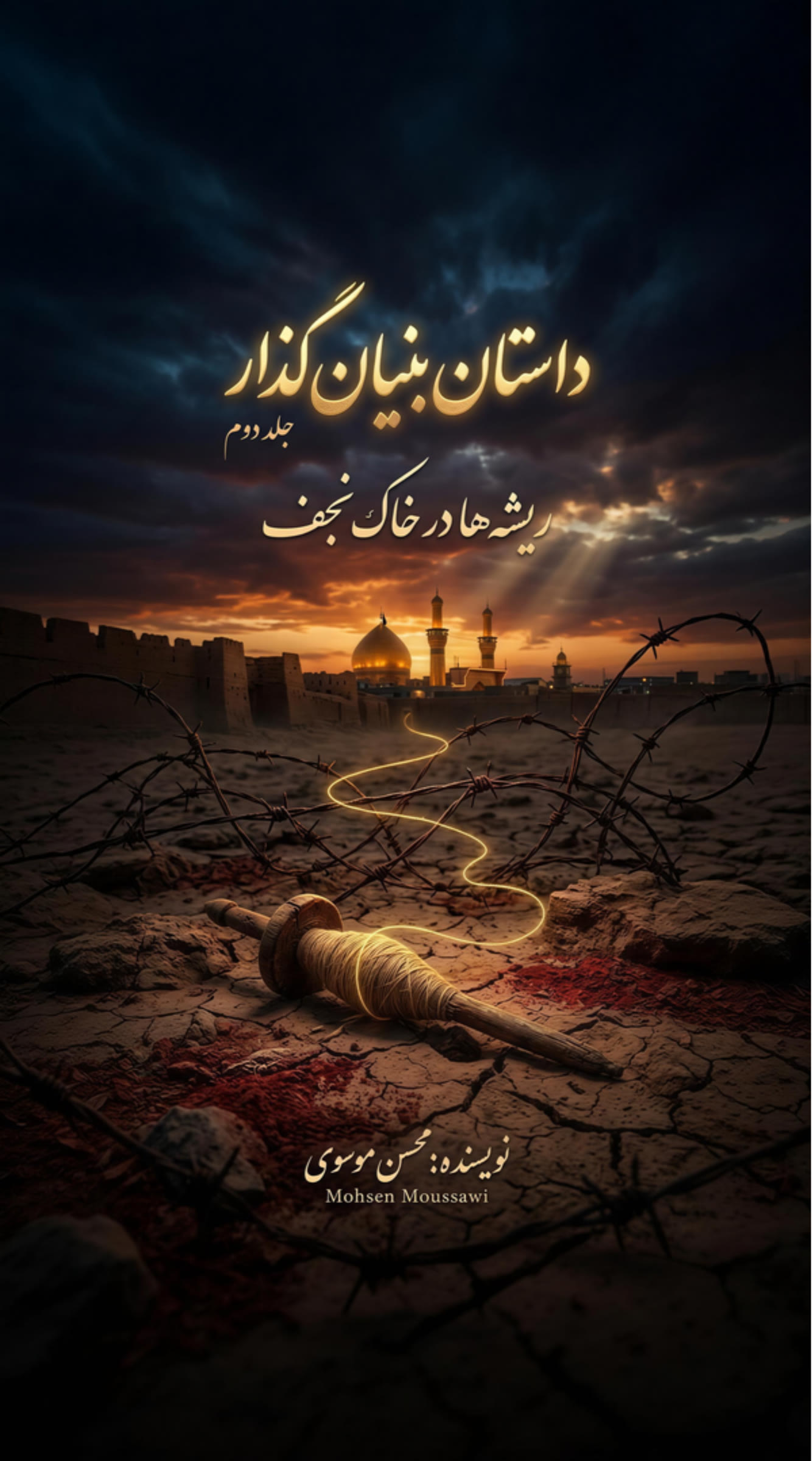
✦ A TRUE STORY
The Founder's Story — Volume Two
A short, true account — in the artist's own words.
❦ The End
The story continues…
Every track on MIBL Radio carries a little more of this voice forward.
This book was written and published here — yours can be too.
Publish your own bookForeword: Roots in the Soil of Najaf
It has always been said that threads do not lie.
Long before wandering oceans, broken boats and wire borders bound our fate to the soil of Australia, everything began in a small, mud-brick courtyard on the edge of the ancient city of Najaf. A woman of quiet dignity and iron endurance named Bibi Fatemeh knelt there every day before the first light, before the first muezzin's voice rose from the golden dome of the shrine, and turned her tired fingers over the old spindles — the mâsulehs.
The rhythmic turning of those spindles was not merely a way to earn bread, a way for a lone and unprotected woman to keep a household moving through the poverty and suffocation of Iraq. That motion was the steady heartbeat of a family destined to be broken apart again and again on the traumatic roads of history, to be born again, and to come through the ashes of wars and captivities alive.
This book is an entirely true account, written with the structure and craft of cinematic non-fiction: an account of the years when Zaher — my father — was still a quiet, thoughtful young man in a small pharmacy in Najaf; the years before the fateful key of my thirteenth birthday had been cut, when the roots of the Mousavi family still breathed in the soil of Najaf.
________________________________________
> 📌 A note from the author on names and details: In this work, in order to protect intellectual rights, respect the privacy of individuals and observe legal considerations, the names of some characters and some places have been changed or given under pseudonyms. What you read in these pages is the bare, honest and true charter of our lives, polished by the magic of the pen and the craft of storytelling.
________________________________________
> © 2026 All rights to this work are reserved. Written by Mohsen Al-Mousavi. Any copying, republication, adaptation, cinematic or theatrical adaptation, audio production, podcast, re-creation by artificial intelligence, or translation into other languages without the written and formal permission of the author is forbidden both in law and in conscience, and the author reserves the right to pursue the matter legally and internationally.
Long before wandering oceans, broken boats and wire borders bound our fate to the soil of Australia, everything began in a small, mud-brick courtyard on the edge of the ancient city of Najaf. A woman of quiet dignity and iron endurance named Bibi Fatemeh knelt there every day before the first light, before the first muezzin's voice rose from the golden dome of the shrine, and turned her tired fingers over the old spindles — the mâsulehs.
The rhythmic turning of those spindles was not merely a way to earn bread, a way for a lone and unprotected woman to keep a household moving through the poverty and suffocation of Iraq. That motion was the steady heartbeat of a family destined to be broken apart again and again on the traumatic roads of history, to be born again, and to come through the ashes of wars and captivities alive.
This book is an entirely true account, written with the structure and craft of cinematic non-fiction: an account of the years when Zaher — my father — was still a quiet, thoughtful young man in a small pharmacy in Najaf; the years before the fateful key of my thirteenth birthday had been cut, when the roots of the Mousavi family still breathed in the soil of Najaf.
________________________________________
> 📌 A note from the author on names and details: In this work, in order to protect intellectual rights, respect the privacy of individuals and observe legal considerations, the names of some characters and some places have been changed or given under pseudonyms. What you read in these pages is the bare, honest and true charter of our lives, polished by the magic of the pen and the craft of storytelling.
________________________________________
> © 2026 All rights to this work are reserved. Written by Mohsen Al-Mousavi. Any copying, republication, adaptation, cinematic or theatrical adaptation, audio production, podcast, re-creation by artificial intelligence, or translation into other languages without the written and formal permission of the author is forbidden both in law and in conscience, and the author reserves the right to pursue the matter legally and internationally.
Chapter One: The House of the Sayyids and a Spark in the Dungeon
## 1. The Scent of Khums and Zakat in the House of the Sayyids
The dusty, winding alleys of Najaf burned under the desert sun, but at the end of one of the city's quiet dead ends stood a house whose shade fell differently from the rest of the neighbourhood.
Its whitewashed mud-and-straw walls sheltered a family of the pure lineage of the Sayyids. In the Najaf of that era, the devout people of the quarter held the House of Mousavi in a reverence close to awe. Bibi Fatemeh — a woman of great dignity who had lost her young husband Mohsen years before — kept this life turning alongside her devoted husband Sedmir, her late husband's brother, who out of plain human honour had become the shade over the heads of the orphans.
The house they breathed in was a gift, the blessing of the neighbourhood's own table. The faithful brought the khums and zakat of their wealth to this family of Sayyids with pride and humility, so that the blessing of Bibi Fatemeh's prayers and her pure lineage might light their quarter. In the small courtyard, under the shade of the single pomegranate tree, a cloth was spread whose bread came from the respect of the people and whose stew came from the devotion of the townsfolk. And Bibi Fatemeh, in the half-dark of dawn, turned her spindles and her old bobbins, so that beside all that public affection she might keep her family's pride and independence intact.
The eldest son of the house, Zaher, was a quiet, thoughtful young man of modest eyes who worked in the neighbourhood pharmacy. Everyone knew him for his decency and his learning. But behind that calm, composed face beat a restless spirit, thirsty to know the world outside.
[[break]]
## 2. The Fever of the Road; From the Syrian Desert to the Edge of Istanbul
Contrary to what everyone assumed — that Zaher was a young man who stayed at home — he was a boundless lover of travel and of roads. His youth burned with a thirst to see distant horizons. Whenever the chance came and he had saved a few dinars, he tied up his small bundle to go and touch the strangeness and the beauty of other cities.
The strongest pull for Zaher was, at first, Syria and the ancient city of Damascus. For days he walked through the covered bazaars, beside the holy shrines, among the lemon blossom and jasmine of Damascus, sitting down to talk with strangers, carrying the horizon of his mind out past the walls of Najaf.
But his appetite for discovering the world did not end in Syria. His next step was a journey into the heart of an old empire: Turkey. Zaher took the northern roads. The architecture of Istanbul, the green fields, the drama of East meeting West in Turkey — all of it turned the soul of this young man from Najaf upside down. He saw the world as larger than the suffocation of Iraq, and with every step he tasted freedom and the act of breathing foreign air.
But no one at home knew that this sweet journey to Turkey was to be the prelude to one of the most terrible tragedies of his life…
[[break]]
## 3. The Ambush on the Way Home; The Ba'athists' Hunting Net
At dusk on a dust-laden day, after weeks of wandering the roads of Syria and Turkey, Zaher set foot on Iraqi soil with a bag full of memories and a mind crowded with images of the free world, on his way back to the arms of Bibi Fatemeh's house.
He had not gone more than a few kilometres from the border checkpoint when two military vehicles of the Ba'ath regime suddenly blocked his path in a flood of dust and the ugly shriek of brakes. Ba'athist officers stepped down in heavy boots, their faces without mercy, and closed in a ring around the young Zaher.
The first accusation was simple, and lethal in the same breath: "Suspected of evading military service!"
The Ba'athists assumed Zaher was an Iraqi youth who had fled to Turkey to dodge service in Saddam's army. With complete composure and calm, Zaher produced his identity papers to prove that nothing was wrong. But a closer inspection of those papers revealed a far heavier secret to the suspicious agents of the state: the Iranian origin and lineage of the Mousavi family.
The moment they understood that Iranian blood ran in the veins of this young Sayyid, their tone and their manner turned a hundred and eighty degrees. Under the racial laws of the Ba'ath regime, military service was forbidden to foreign nationals and dependants; so the charge of "evading service" fell away, and something far blacker took its place: the charge of spying and of being an alien.
They treated him not as a citizen but as a "suspicious man of Iranian descent" who had travelled to Turkey and Syria. They gave him the whip and their insults, and with no legal cause and no order from any court they threw him into the back of a metal truck and drove him towards one of the most feared prisons of the Ba'ath.
[[break]]
## 4. Six Months in a Hell of Hatred and Racism
Young Zaher was flung, in an instant, from the warm embrace of the House of the Sayyids and the scent of Damascene jasmine into a dark, damp, suffocating dungeon. A dungeon that swallowed him whole for six entire months.
"Years later, in the small, shabby house my father Zaher rented in the west of Sydney, he had become an ailing, exhausted man with a spirit worn very thin, a man whose stature and strength the heavy weight of exile and displacement had taken from him. In the quiet, plain corner of his house, when he lit a cigarette with trembling hands and stared into some corner with a sigh so deep it shook every joint of his body, he would tell me — in a broken voice that after decades still carried the smell of the wound — about those six months of torture and racial hatred in the dungeons of the Ba'ath…"
He spoke of relentless torture. Of nights when, in the absolute darkness of the cell, the moaning, the screaming under the whip and the pleading of innocent prisoners echoed through the stone corridors and stole the sleep from his eyes. The Ba'athist mercenaries carried a racial hatred without limit towards anyone of Iranian descent. They subjected Zaher daily — purely for his blood and his lineage — to the harshest physical and psychological cruelty and humiliation.
Every day in that prison passed like a year. Zaher, the well-dressed young traveller who only yesterday had been walking the bazaars of Istanbul, now sat with a wounded body and ragged clothes on the wet floor of a cell, a witness to the naked brutality of Saddam's rule.
[[break]]
## 5. The Spark of Escape in the Heart of the Dark
In those same six ominous months, while Zaher lay on the cold floor of the prison and listened to the wailing of the tortured in the neighbouring cells, something fundamental changed in his spirit.
He understood that in this soil there was no room left for trust, for dignity, or for the lives of decent people. He understood that his family's presence in Najaf rested on a powder magazine of hatred and racism that might set the House of the Sayyids alight at any moment.
On one of those black prison nights, exactly then, as he raised his wounded hands towards the damp ceiling of the cell in prayer, the first sparks of the thought of escaping Iraq for Iran flashed in his mind.
He made himself a promise: "If I get out of this hell alive, I will not stay one more second in this country. I have to find a way to escape to Iran…"
After six months without any news, Bibi Fatemeh and Sedmir, by bribing and pleading with the authorities, managed to take Zaher's half-dead, broken body out of the prison and bring him home.
Zaher came home; but the young man who walked out of that prison was not the person who had gone in. Something resolute, bitter and secret had entered his eyes. He had forged the key to his escape in his own heart, and now the time had come for Bibi Fatemeh to raise the matter of asking for Marziyeh's hand, from Iran…
The dusty, winding alleys of Najaf burned under the desert sun, but at the end of one of the city's quiet dead ends stood a house whose shade fell differently from the rest of the neighbourhood.
Its whitewashed mud-and-straw walls sheltered a family of the pure lineage of the Sayyids. In the Najaf of that era, the devout people of the quarter held the House of Mousavi in a reverence close to awe. Bibi Fatemeh — a woman of great dignity who had lost her young husband Mohsen years before — kept this life turning alongside her devoted husband Sedmir, her late husband's brother, who out of plain human honour had become the shade over the heads of the orphans.
The house they breathed in was a gift, the blessing of the neighbourhood's own table. The faithful brought the khums and zakat of their wealth to this family of Sayyids with pride and humility, so that the blessing of Bibi Fatemeh's prayers and her pure lineage might light their quarter. In the small courtyard, under the shade of the single pomegranate tree, a cloth was spread whose bread came from the respect of the people and whose stew came from the devotion of the townsfolk. And Bibi Fatemeh, in the half-dark of dawn, turned her spindles and her old bobbins, so that beside all that public affection she might keep her family's pride and independence intact.
The eldest son of the house, Zaher, was a quiet, thoughtful young man of modest eyes who worked in the neighbourhood pharmacy. Everyone knew him for his decency and his learning. But behind that calm, composed face beat a restless spirit, thirsty to know the world outside.
[[break]]
## 2. The Fever of the Road; From the Syrian Desert to the Edge of Istanbul
Contrary to what everyone assumed — that Zaher was a young man who stayed at home — he was a boundless lover of travel and of roads. His youth burned with a thirst to see distant horizons. Whenever the chance came and he had saved a few dinars, he tied up his small bundle to go and touch the strangeness and the beauty of other cities.
The strongest pull for Zaher was, at first, Syria and the ancient city of Damascus. For days he walked through the covered bazaars, beside the holy shrines, among the lemon blossom and jasmine of Damascus, sitting down to talk with strangers, carrying the horizon of his mind out past the walls of Najaf.
But his appetite for discovering the world did not end in Syria. His next step was a journey into the heart of an old empire: Turkey. Zaher took the northern roads. The architecture of Istanbul, the green fields, the drama of East meeting West in Turkey — all of it turned the soul of this young man from Najaf upside down. He saw the world as larger than the suffocation of Iraq, and with every step he tasted freedom and the act of breathing foreign air.
But no one at home knew that this sweet journey to Turkey was to be the prelude to one of the most terrible tragedies of his life…
[[break]]
## 3. The Ambush on the Way Home; The Ba'athists' Hunting Net
At dusk on a dust-laden day, after weeks of wandering the roads of Syria and Turkey, Zaher set foot on Iraqi soil with a bag full of memories and a mind crowded with images of the free world, on his way back to the arms of Bibi Fatemeh's house.
He had not gone more than a few kilometres from the border checkpoint when two military vehicles of the Ba'ath regime suddenly blocked his path in a flood of dust and the ugly shriek of brakes. Ba'athist officers stepped down in heavy boots, their faces without mercy, and closed in a ring around the young Zaher.
The first accusation was simple, and lethal in the same breath: "Suspected of evading military service!"
The Ba'athists assumed Zaher was an Iraqi youth who had fled to Turkey to dodge service in Saddam's army. With complete composure and calm, Zaher produced his identity papers to prove that nothing was wrong. But a closer inspection of those papers revealed a far heavier secret to the suspicious agents of the state: the Iranian origin and lineage of the Mousavi family.
The moment they understood that Iranian blood ran in the veins of this young Sayyid, their tone and their manner turned a hundred and eighty degrees. Under the racial laws of the Ba'ath regime, military service was forbidden to foreign nationals and dependants; so the charge of "evading service" fell away, and something far blacker took its place: the charge of spying and of being an alien.
They treated him not as a citizen but as a "suspicious man of Iranian descent" who had travelled to Turkey and Syria. They gave him the whip and their insults, and with no legal cause and no order from any court they threw him into the back of a metal truck and drove him towards one of the most feared prisons of the Ba'ath.
[[break]]
## 4. Six Months in a Hell of Hatred and Racism
Young Zaher was flung, in an instant, from the warm embrace of the House of the Sayyids and the scent of Damascene jasmine into a dark, damp, suffocating dungeon. A dungeon that swallowed him whole for six entire months.
"Years later, in the small, shabby house my father Zaher rented in the west of Sydney, he had become an ailing, exhausted man with a spirit worn very thin, a man whose stature and strength the heavy weight of exile and displacement had taken from him. In the quiet, plain corner of his house, when he lit a cigarette with trembling hands and stared into some corner with a sigh so deep it shook every joint of his body, he would tell me — in a broken voice that after decades still carried the smell of the wound — about those six months of torture and racial hatred in the dungeons of the Ba'ath…"
He spoke of relentless torture. Of nights when, in the absolute darkness of the cell, the moaning, the screaming under the whip and the pleading of innocent prisoners echoed through the stone corridors and stole the sleep from his eyes. The Ba'athist mercenaries carried a racial hatred without limit towards anyone of Iranian descent. They subjected Zaher daily — purely for his blood and his lineage — to the harshest physical and psychological cruelty and humiliation.
Every day in that prison passed like a year. Zaher, the well-dressed young traveller who only yesterday had been walking the bazaars of Istanbul, now sat with a wounded body and ragged clothes on the wet floor of a cell, a witness to the naked brutality of Saddam's rule.
[[break]]
## 5. The Spark of Escape in the Heart of the Dark
In those same six ominous months, while Zaher lay on the cold floor of the prison and listened to the wailing of the tortured in the neighbouring cells, something fundamental changed in his spirit.
He understood that in this soil there was no room left for trust, for dignity, or for the lives of decent people. He understood that his family's presence in Najaf rested on a powder magazine of hatred and racism that might set the House of the Sayyids alight at any moment.
On one of those black prison nights, exactly then, as he raised his wounded hands towards the damp ceiling of the cell in prayer, the first sparks of the thought of escaping Iraq for Iran flashed in his mind.
He made himself a promise: "If I get out of this hell alive, I will not stay one more second in this country. I have to find a way to escape to Iran…"
After six months without any news, Bibi Fatemeh and Sedmir, by bribing and pleading with the authorities, managed to take Zaher's half-dead, broken body out of the prison and bring him home.
Zaher came home; but the young man who walked out of that prison was not the person who had gone in. Something resolute, bitter and secret had entered his eyes. He had forged the key to his escape in his own heart, and now the time had come for Bibi Fatemeh to raise the matter of asking for Marziyeh's hand, from Iran…
The story continues…
Every track on MIBL Radio carries a little more of this voice forward.
Contents
Now playing
Tap to enable sound
Enjoying the story?
You've reached the end of the free preview. Support the author with a A$3.00 tip to unlock the rest of the book — it goes straight to them.
Secure checkout — Apple Pay, Google Pay or card.
You just finished a chapter.
Someone sat down and wrote that. If it was worth your time, tell them so — it goes straight to them.
Apple Pay, Google Pay or card — one tap.