


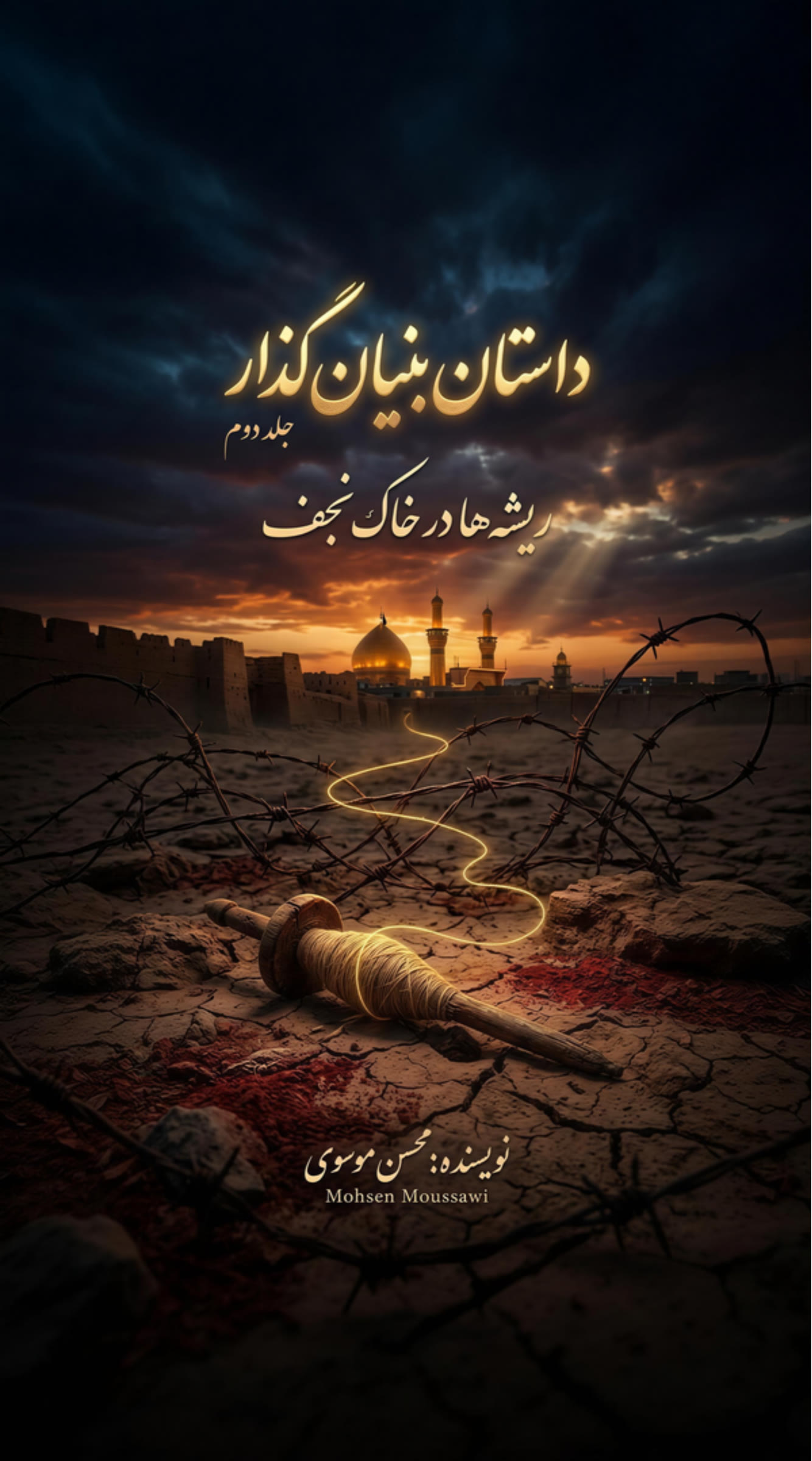
✦ A TRUE STORY
The Founder's Story — Volume Two
A short, true account — in the artist's own words.
❦ The End
The story continues…
Every track on MIBL Radio carries a little more of this voice forward.
This book was written and published here — yours can be too.
Publish your own bookForeword: Roots in the Soil of Najaf
It has always been said that threads do not lie.
Long before wandering oceans, broken boats and wire borders bound our fate to the soil of Australia, everything began in a small, mud-brick courtyard on the edge of the ancient city of Najaf. A woman of quiet dignity and iron endurance named Bibi Fatemeh knelt there every day before the first light, before the first muezzin's voice rose from the golden dome of the shrine, and turned her tired fingers over the old spindles — the mâsulehs.
The rhythmic turning of those spindles was not merely a way to earn bread, a way for a lone and unprotected woman to keep a household moving through the poverty and suffocation of Iraq. That motion was the steady heartbeat of a family destined to be broken apart again and again on the traumatic roads of history, to be born again, and to come through the ashes of wars and captivities alive.
This book is an entirely true account, written with the structure and craft of cinematic non-fiction: an account of the years when Zaher — my father — was still a quiet, thoughtful young man in a small pharmacy in Najaf; the years before the fateful key of my thirteenth birthday had been cut, when the roots of the Mousavi family still breathed in the soil of Najaf.
________________________________________
> 📌 A note from the author on names and details: In this work, in order to protect intellectual rights, respect the privacy of individuals and observe legal considerations, the names of some characters and some places have been changed or given under pseudonyms. What you read in these pages is the bare, honest and true charter of our lives, polished by the magic of the pen and the craft of storytelling.
________________________________________
> © 2026 All rights to this work are reserved. Written by Mohsen Al-Mousavi. Any copying, republication, adaptation, cinematic or theatrical adaptation, audio production, podcast, re-creation by artificial intelligence, or translation into other languages without the written and formal permission of the author is forbidden both in law and in conscience, and the author reserves the right to pursue the matter legally and internationally.
Chapter One: The House of the Sayyids and a Spark in the Dungeon
## 1. The Scent of Khums and Zakat in the House of the Sayyids
The dusty, winding alleys of Najaf burned under the desert sun, but at the end of one of the city's quiet dead ends stood a house whose shade fell differently from the rest of the neighbourhood.
Its whitewashed mud-and-straw walls sheltered a family of the pure lineage of the Sayyids. In the Najaf of that era, the devout people of the quarter held the House of Mousavi in a reverence close to awe. Bibi Fatemeh — a woman of great dignity who had lost her young husband Mohsen years before — kept this life turning alongside her devoted husband Sedmir, her late husband's brother, who out of plain human honour had become the shade over the heads of the orphans.
The house they breathed in was a gift, the blessing of the neighbourhood's own table. The faithful brought the khums and zakat of their wealth to this family of Sayyids with pride and humility, so that the blessing of Bibi Fatemeh's prayers and her pure lineage might light their quarter. In the small courtyard, under the shade of the single pomegranate tree, a cloth was spread whose bread came from the respect of the people and whose stew came from the devotion of the townsfolk. And Bibi Fatemeh, in the half-dark of dawn, turned her spindles and her old bobbins, so that beside all that public affection she might keep her family's pride and independence intact.
The eldest son of the house, Zaher, was a quiet, thoughtful young man of modest eyes who worked in the neighbourhood pharmacy. Everyone knew him for his decency and his learning. But behind that calm, composed face beat a restless spirit, thirsty to know the world outside.
[[break]]
## 2. The Fever of the Road; From the Syrian Desert to the Edge of Istanbul
Contrary to what everyone assumed — that Zaher was a young man who stayed at home — he was a boundless lover of travel and of roads. His youth burned with a thirst to see distant horizons. Whenever the chance came and he had saved a few dinars, he tied up his small bundle to go and touch the strangeness and the beauty of other cities.
The strongest pull for Zaher was, at first, Syria and the ancient city of Damascus. For days he walked through the covered bazaars, beside the holy shrines, among the lemon blossom and jasmine of Damascus, sitting down to talk with strangers, carrying the horizon of his mind out past the walls of Najaf.
But his appetite for discovering the world did not end in Syria. His next step was a journey into the heart of an old empire: Turkey. Zaher took the northern roads. The architecture of Istanbul, the green fields, the drama of East meeting West in Turkey — all of it turned the soul of this young man from Najaf upside down. He saw the world as larger than the suffocation of Iraq, and with every step he tasted freedom and the act of breathing foreign air.
But no one at home knew that this sweet journey to Turkey was to be the prelude to one of the most terrible tragedies of his life…
[[break]]
## 3. The Ambush on the Way Home; The Ba'athists' Hunting Net
At dusk on a dust-laden day, after weeks of wandering the roads of Syria and Turkey, Zaher set foot on Iraqi soil with a bag full of memories and a mind crowded with images of the free world, on his way back to the arms of Bibi Fatemeh's house.
He had not gone more than a few kilometres from the border checkpoint when two military vehicles of the Ba'ath regime suddenly blocked his path in a flood of dust and the ugly shriek of brakes. Ba'athist officers stepped down in heavy boots, their faces without mercy, and closed in a ring around the young Zaher.
The first accusation was simple, and lethal in the same breath: "Suspected of evading military service!"
The Ba'athists assumed Zaher was an Iraqi youth who had fled to Turkey to dodge service in Saddam's army. With complete composure and calm, Zaher produced his identity papers to prove that nothing was wrong. But a closer inspection of those papers revealed a far heavier secret to the suspicious agents of the state: the Iranian origin and lineage of the Mousavi family.
The moment they understood that Iranian blood ran in the veins of this young Sayyid, their tone and their manner turned a hundred and eighty degrees. Under the racial laws of the Ba'ath regime, military service was forbidden to foreign nationals and dependants; so the charge of "evading service" fell away, and something far blacker took its place: the charge of spying and of being an alien.
They treated him not as a citizen but as a "suspicious man of Iranian descent" who had travelled to Turkey and Syria. They gave him the whip and their insults, and with no legal cause and no order from any court they threw him into the back of a metal truck and drove him towards one of the most feared prisons of the Ba'ath.
[[break]]
## 4. Six Months in a Hell of Hatred and Racism
Young Zaher was flung, in an instant, from the warm embrace of the House of the Sayyids and the scent of Damascene jasmine into a dark, damp, suffocating dungeon. A dungeon that swallowed him whole for six entire months.
"Years later, in the small, shabby house my father Zaher rented in the west of Sydney, he had become an ailing, exhausted man with a spirit worn very thin, a man whose stature and strength the heavy weight of exile and displacement had taken from him. In the quiet, plain corner of his house, when he lit a cigarette with trembling hands and stared into some corner with a sigh so deep it shook every joint of his body, he would tell me — in a broken voice that after decades still carried the smell of the wound — about those six months of torture and racial hatred in the dungeons of the Ba'ath…"
He spoke of relentless torture. Of nights when, in the absolute darkness of the cell, the moaning, the screaming under the whip and the pleading of innocent prisoners echoed through the stone corridors and stole the sleep from his eyes. The Ba'athist mercenaries carried a racial hatred without limit towards anyone of Iranian descent. They subjected Zaher daily — purely for his blood and his lineage — to the harshest physical and psychological cruelty and humiliation.
Every day in that prison passed like a year. Zaher, the well-dressed young traveller who only yesterday had been walking the bazaars of Istanbul, now sat with a wounded body and ragged clothes on the wet floor of a cell, a witness to the naked brutality of Saddam's rule.
[[break]]
## 5. The Spark of Escape in the Heart of the Dark
In those same six ominous months, while Zaher lay on the cold floor of the prison and listened to the wailing of the tortured in the neighbouring cells, something fundamental changed in his spirit.
He understood that in this soil there was no room left for trust, for dignity, or for the lives of decent people. He understood that his family's presence in Najaf rested on a powder magazine of hatred and racism that might set the House of the Sayyids alight at any moment.
On one of those black prison nights, exactly then, as he raised his wounded hands towards the damp ceiling of the cell in prayer, the first sparks of the thought of escaping Iraq for Iran flashed in his mind.
He made himself a promise: "If I get out of this hell alive, I will not stay one more second in this country. I have to find a way to escape to Iran…"
After six months without any news, Bibi Fatemeh and Sedmir, by bribing and pleading with the authorities, managed to take Zaher's half-dead, broken body out of the prison and bring him home.
Zaher came home; but the young man who walked out of that prison was not the person who had gone in. Something resolute, bitter and secret had entered his eyes. He had forged the key to his escape in his own heart, and now the time had come for Bibi Fatemeh to raise the matter of asking for Marziyeh's hand, from Iran…
Chapter Two: The Suitcase of Chocolates and the Ominous Ultimatum
## 1. A Mother's Dream on the Edge of the Storm
Days passed after Zaher's release from those six nightmarish months in the Ba'ath prison. The physical wounds of the torture were slowly closing, but the black, suffocating shadow of Saddam's rule grew heavier over Najaf with every passing day. News of young men of Iranian descent vanishing without warning, of interrogations carried out in the street, had settled over every alley like an evil dust.
In the middle of all that dread, Bibi Fatemeh — the patient, dignified matriarch of the family — had fixed her eyes on one bright point on the horizon of the future. She who had turned the wheel of her children's lives in exile for years by turning her spinning bobbins, was nursing one great wish: to see her eldest son, Zaher, married and settled.
Bibi Fatemeh knew perfectly well that Iraq's political and economic condition was heading for ruin. She believed that if she placed Zaher's hand in the hand of her brother's daughter, Marziyeh, who lived with her family in Iran, Zaher would not only find stability and peace — a safe family foothold would also be established on Iranian soil for the day disaster came.
Zaher was a quiet, modest, unassuming young man who worked all day in the neighbourhood pharmacy. When Bibi Fatemeh raised the question of asking for Marziyeh's hand, Zaher raised no objection at all: with a man's shy reticence and a silence brimming with respect, he accepted his mother's authority.
At last Bibi Fatemeh gathered her courage; she took up a sheet of paper and with hands full of hope wrote a registered letter to her brother Hossein in Iran, proposing the sacred union of Zaher and Marziyeh.
[[break]]
## 2. A Suitcase Full of Chocolates and Photographs of Marziyeh
Waiting for a reply from Iran filled the small Najaf courtyard with days of fear and hope. Bibi Fatemeh murmured prayers under her breath as she turned her bobbins, and the daughters of the house — Zohreh, Halimeh, Roya and Parvin — whispered together about the family's future bride.
One afternoon the wooden bell of the courtyard rang, and a letter arrived from Iran together with a parcel. Bibi Fatemeh's brother had agreed to the match with complete enthusiasm. But with the letter had come a large travelling suitcase that drowned the courtyard of the House of the Sayyids in joy and ululation: a suitcase full of delicious chocolates, Persian sweets, sweet-smelling gifts, and several photographs of Marziyeh in her chador, with a face at once noble and innocent.
The children and young people of the house crowded round the suitcase. Uncle Jalal, with his usual humour, handed the chocolates out among everyone, and laughter filled the courtyard. Marziyeh's photographs passed from hand to hand. With tears of joy in her eyes, Bibi Fatemeh showed one to Zaher. Zaher gazed at the pure face of his future wife, and a soft, bashful smile settled on his lips. That afternoon, the scent of chocolate and the heavenly dream of the future made everyone forget, for a few hours, the hell of Saddam's rule.
With fresh joy and hope, Zaher slipped a silver ring onto the finger of his right hand, the sign of an engagement and of a man about to be married.
[[break]]
## 3. Whispers in the Pharmacy and the Ba'athist Ambush
But under a regime built on repression, fate throws its shadow even across happiness.
The days passed and Zaher, as usual, was busy in the pharmacy with herbal remedies and handing out medicines to the people of the quarter. On one hot day, an old friend and customer noticed the silver ring on Zaher's right hand. Smiling, his friend squeezed his hand and congratulated him.
And Zaher, in the fullness of his simplicity and the purity and innocence of his soul, told the secret of his heart, and said with pride that he had recently asked for the hand of his cousin Marziyeh in Iran and would soon be leaving for Iran to build a life.
Zaher did not know that in that city even the mud walls have ears, and that the informers of the Ba'ath regime walked the bazaar dressed as customers. The news that this young man of Iranian descent was engaged to a girl in Iran reached the security forces and the secret police at once. To Saddam's regime, which had just entered a phase of severe border tension and persecution of Iranians, any connection with Iran counted as espionage and treason.
The next morning, as Zaher was walking to work, a Ba'athist military vehicle suddenly braked at the kerb. Two armed soldiers got out, forced Zaher into the car and bound his eyes.
[[break]]
## 4. A Dark Interrogation and an Ominous Ultimatum
They took Zaher to one of Najaf's security detention centres. Ba'athist interrogators pressed him in a harsh, threatening tone and beat him. They were trying to prove that he intended to join the Iranian army or to pass information. But Zaher's composure, his decency and his honest answers — and the complete absence of any evidence — meant they could not uncover any hidden identity in him.
Even so, before they released him, the Ba'athist commander came forward with a merciless face and delivered an ominous ultimatum: "You are going free, but there is one condition. Either you put the idea of marrying that Iranian girl out of your head today and stay in Iraq, or within a few days you will be exiled and expelled from this country for good."
Zaher came home half-dead and covered in wounds. When Bibi Fatemeh and the rest of the family saw the state of his body, the house drowned in weeping and panic. Zaher told them about the interrogation and the Ba'athists' ultimatum.
Bibi Fatemeh collapsed from grief and illness, murmuring to herself: "I wish I had never asked for Marziyeh, so my son would not have come to this…"
But Zaher had made up his mind. He turned to Bibi Fatemeh and said firmly: "Mother, I will not stay in this soil. I am going to Iran to marry Marziyeh and to build a new life on dignity."
[[break]]
## 5. The Storm of the Escape and a Farewell at Midnight
Zaher's decision to escape into Iran by smuggler carried lethal risks. In those days Iraq's borders were mined, and Saddam's patrols shot at every runaway.
When they heard Zaher's decision, two more members of the family stepped forward:
• Aunt Khadijeh: the eldest sister, long since separated from her husband, with two small children named Sina and Sara, said with courage and a mother's instinct that she would go with Zaher to look after him.
• Uncle Jalal: the clever brother, an electrician, whose skilled hands and quick mind could save the group along the road.
Seeing three of her children about to set out on the road of death, Bibi Fatemeh had no choice but to yield. To pay the smugglers and cover the cost of the escape she put in everything she had saved: she sold her personal jewellery, the household goods, and even her precious old spindles and bobbins, so there would be money for her children's ticket to freedom.
The night of the escape came. The House of the Sayyids sank into a heavy silence choked with tears. Bibi Fatemeh gave Zaher a small bag holding the letters and some money, pressed Khadijeh's hands and said: "You are the eldest. Be like a mother to your brothers…"
It was past midnight when the smugglers appeared at the door. Zaher, Jalal and Khadijeh, together with little Sina and Sara, left their father's house in the absolute darkness of the night and vanished like light shadows among the dusty alleys of Najaf.
Bibi Fatemeh knelt on the courtyard steps, beneath the shade of the single pomegranate tree, gathered her empty bobbins into her arms and with streaming eyes gave her children into the safe hands of God — without knowing what epic their escape through the minefields would begin on the soil of Iran…
Chapter Three: Crossing the Minefields and a Marriage in Isfahan
## 1. The Road of Death; The Mined Pass and the Desert Nights
Escaping the Iraq of the Ba'ath regime in the closing years of the 1970s was a wholly bloody gamble, the equal of death. Saddam Hussein had ordered every border mined and the army patrols to fire on any moving shadow without warning.
The smugglers led Zaher's small group through winding tracks and remote desert passes. At night the bone-cutting cold of the desert lashed their bodies; by day the blast of the sun drained the strength out of them. Aunt Khadijeh hid little Sina and Sara under her chador to keep them safe from the hard wind and the desert dust. Sina cried out several times from thirst and exhaustion, but Zaher lifted him onto his shoulders and carried him for miles through the dusty sand.
The most terrifying part of the journey was the crossing of the border minefields. The smugglers went ahead, probing with thin metal rods for the traces of wires and mines hidden under the soil. Zaher and Jalal had to place their feet exactly where the smugglers had placed theirs. A single centimetre of slipping would have been enough for one appalling blast to turn everything to ash.
At one of the minor checkpoints near the border, the searchlight of a Ba'athist post suddenly fell on the group. The soldiers shouted at them to halt. Zaher and Khadijeh froze in terror. In those lethal seconds, Uncle Jalal stepped forward with his extraordinary quickness of mind. In fluent Arabic and a completely level tone he told an invented story about little Sara's grave illness and an emergency journey to the neighbouring village. The suspicion of the Ba'athist soldiers subsided at the sight of Sara's feverish, drained face, and they let them pass. With nothing but simple tools and a warm tongue, Uncle Jalal pulled them out of the dragon's mouth.
[[break]]
## 2. The Dawn of Freedom at the Iranian Border
After days of punishing walking, hunger and trembling in fear of the patrols, at dawn on a sunlit day the smugglers at last reached a high point and pointed to the horizon.
Ahead of them stood the border post, and Iran's three-coloured flag danced in the morning breeze.
At the sight of that flag the dam of Aunt Khadijeh's tears and Zaher's broke. They knelt on the warm soil of the border, kissed the ground and gave thanks to God. The Iranian border guards, seeing their disordered state, their torn clothes and their dust-covered faces, hurried forward. Unlike the cruelty and the heavy boots of the Ba'athists, the Iranian guards came to meet them with open arms, warm bread, water and blankets.
And so Zaher, after six months of nightmarish torture in the dungeons of the Ba'ath and days of running through minefields, drew his first breath of freedom and safety. He felt he had returned from the world of the dead to begin a new life.
[[break]]
## 3. Reaching Isfahan and Meeting Uncle Hossein
After registering their basic details and issuing residence cards for foreign nationals, the border guards arranged their onward journey to Isfahan.
Isfahan — with its rushing Zayandeh Rud, its historic bridges and its streets full of plane trees — was like a green paradise to Zaher and Jalal. They made their way to the district where Uncle Hossein lived: Bibi Fatemeh's brother and Marziyeh's father.
When the doorbell of Uncle Hossein's house rang and he saw his exiled nephews and niece standing there, weeping and cries of joy filled the house. Uncle Hossein pulled Zaher, Jalal and Khadijeh hard into his arms. The news of their successful escape from Iraq came as balm to Bibi Fatemeh's anxious heart in Najaf, reaching her through the letters that followed.
That same afternoon, for the first time, Zaher and Marziyeh stood face to face.
Marziyeh came into the room with a tray of tea — a girl with an innocent face, wide and honest eyes, and a chador she wore with dignity. Zaher, who until then had seen only her small photographs in the suitcase of gifts, looked at his future wife with a man's shyness and lowered eyes. In the light of that room, the hidden glances of those two promised a bond of love, of respect, and of the calm that comes after a storm.
[[break]]
## 4. The Sacred Bond and the Beginning of a Life in Exile
A few days later a simple cloth, laden with blessing and affection, was spread in Uncle Hossein's house.
The cleric pronounced the marriage of Zaher and Marziyeh. With a quiet, bashful "yes", Marziyeh made the sacred bond official, and Zaher pressed the silver ring more firmly onto his finger and pledged to give his whole life to this woman's happiness. In those same days Uncle Jalal also married his cousin Homeyra, and the family's happiness was complete.
A new life began in Iran. Although the Iranian government did not grant birth certificates to migrants of Iraqi origin, and they lived on a foreign national's residence card alone, Zaher — with his knowledge of pharmacy — began work immediately in a respected pharmacy in Isfahan. Uncle Jalal, with his pliers and his voltage tester, took on the wiring of workshops and houses. Aunt Khadijeh, with her skill as a seamstress, kept the wheel of her own life and her two children's turning.
Several years passed… until on the first of March 1982 a baby boy was born in Isfahan; a boy they named Mohsen — the one who would, in time, become the narrator and the scribe of this epic…
Chapter Four: Bibi's Captivity and the Catastrophe of Losing Mohammad
## 1. The Heavy Shadow of Absence and the Sons Who Held the House Up
After the midnight escape of Zaher, Uncle Jalal and Aunt Khadijeh towards the Iranian border, the House of the Sayyids in Najaf entered a time full of unrest, of silence, of fear and hope.
Bibi Fatemeh, though her heart burned at the loss of three of her children, kept the household turning with a steadiness beyond compare, borrowed from the roots of the Sayyids. In this period the shape of the family changed:
• Zohreh and Halimeh, the eldest daughters of the house, married and left with a thousand hopes for homes of their own in Iraq.
• At home, apart from Bibi Fatemeh, only Roya and Parvin remained to help their mother with the housework and the old spinning.
The heavy burden of earning the bread and running the house in that time of hardship and severe food shortage fell on the shoulders of the family's three young sons: Ali, Nader, and — most of all — Mohammad.
Mohammad was a composed, dignified boy full of the appetite for life, barely eighteen. He dreamed of becoming a teacher; and after his elder brothers fled, he rolled up his sleeves with a man's honour and worked day and night so that Bibi Fatemeh's table would never be empty. Mohammad had become Bibi's support and the staff in her hand. Every evening when he came home he would kiss his mother's hands first, wipe the day's exhaustion off her with his gentle laughter, and assure her that as long as he was there no storm could shake the roof of that house.
But the fire of the Iran–Iraq war blazed hotter by the day, and the Ba'ath regime turned its racial hatred more and more towards families of Iranian descent.
[[break]]
## 2. Nanneh Sa'd's Trust and the Storming of the Ba'athist Boots
The year 1984 arrived. Najaf was no longer that quiet city of golden domes; it had become one great prison, full of armed patrols, street interrogations and threats written on the walls. News of agents storming the homes of people of Iranian descent and confiscating their property ran through the quarter like lightning.
Bibi Fatemeh, with a mother's intelligence and foresight, could see the black days coming. She knew perfectly well that the turn of the House of the Sayyids would come soon. And so, in order that the only keepsake of her husband and the roof over her children's heads might be safe from the Ba'athist state's plundering, she secretly entrusted the deed and the key of the house to her loyal friend and neighbour, "Nanneh Sa'd". Bibi pressed Nanneh Sa'd's hands and said in a trembling voice: "Nanneh Sa'd… let this house and these bricks be the trust of the Prophet's family with you. Keep it safe until the day my children come home…"
Bibi's foresight was proved true very soon.
On a hot, sunlit morning, the silence of the dead-end alley broke under the ugly shriek of brakes from several Ba'athist military trucks. Rough soldiers in heavy boots broke the wooden courtyard door without any warning and stormed into the house.
The Ba'athist commander shouted, his tone full of insult and violence: "You are the enemies and traitors of Iraq! You do not have the right to stay one second! You will take nothing with you — everything belongs to the state!"
The Ba'athists showed no mercy at all. They drove Bibi Fatemeh, Aunt Roya, Aunt Parvin, Mohammad, Ali and Uncle Nader towards the courtyard gate with blows and humiliation. Bibi Fatemeh was not even given time to set her chador properly on her head or to put on her shoes. The agents threw the family of Sayyids into the back of a hot metal truck, its canvas cover burning under the blast of the sun, and carried them away from the only home they had built with their heart's blood.
[[break]]
## 3. The Hell of the Detention Centre and Bibi's Wailing
The truck took the family, along with dozens of other families, to one of the largest and most crowded public detention centres on the outskirts of Najaf.
It was a real hell. A great filthy, suffocating shed in which the smell of fear, of sweat and of infection hung in waves. Hundreds of women, men, children and sick old men huddled on the dirty ground. The wailing of mothers who had lost their children in the crush, the moaning of the sick without medicine and the drunken laughter of the Ba'athist soldiers filled the air. Anyone who protested was left bloodied under the whips and cables of the Ba'athist guards.
The shared accusation against all those thousands of human beings was one thing only: having Iranian blood and Iranian lineage.
Bibi Fatemeh gathered her children around her like a bird stripped of its feathers. She drew her chador over her daughters' heads and gripped Mohammad's and Ali's hands hard in hers. With the meagre rationing of whatever scraps of dry bread she could find, and by murmuring verses of the Qur'an under her breath, she tried to keep the light of hope alive in that absolute darkness.
But the most terrible event in the history of the Mousavi family happened in that very detention centre…
[[break]]
## 4. The Catastrophe of Losing Mohammad; "Mother… be strong!"
The next morning a group of senior Ba'athist officers suddenly entered the shed with lists in their hands. They began searching for the grown boys and the young men.
The hard eyes of one officer locked onto Mohammad's fresh, strong, innocent face. The officer pointed at Mohammad and ordered his soldiers: "Separate this one! He is to be transferred to the youth camp."
At those words, everything went dark for Bibi Fatemeh. Like a wounded lioness she threw herself in front of the soldiers, pulled Mohammad into her arms and cried out with sobs and moans that scorched the soul: "For God's sake… have mercy! He is still a child… he is my hope! Let him come with his mother… kill us both together, but do not take him from me!"
But the hearts of the Ba'athists were made of stone and hatred. Their official pretext was that young men must not be exiled to Iran, in case they joined the Iranian army.
Two huge soldiers dragged Bibi Fatemeh's frail hands away with complete brutality and threw her onto the dirt floor of the detention centre. Bibi crawled across the ground, clutching at the soldiers' boots, begging. Mohammad struggled, pulling at the collars of the soldiers, shouting, trying to free himself and get back into his mother's arms, but the heavy cables came down on his head and face.
The soldiers dragged the young Mohammad towards the exit of the shed.
At the last moment, right on the threshold, Mohammad turned his head towards his mother, his face drowned in tears. His eyes locked into Bibi Fatemeh's bloodied, weeping eyes. And in a voice that carried, a voice that would echo through the corridors of time forever, he shouted:
"Mother… be strong! I will find a way back to you… Mother, be strong!"
Mohammad's voice was cut off, and the dark doorway swallowed him.
Bibi Fatemeh crumpled onto the dirt of the detention centre. The wail that came out of her chest shook the earth and the sky. That day, Mohammad disappeared for ever. Nearly twenty years went by, and not a trace, not a letter, not a word of him was ever found; a young man who faded away, wronged, in the nameless dungeons of Saddam, and whose loss stayed burning in Bibi Fatemeh's heart until the day she died.
[[break]]
## 5. Forced Expulsion Across the Border and Iran's Tearful Embrace
After eighteen-year-old Uncle Mohammad was torn from Bibi Fatemeh's arms in a way that cuts the heart out of a person, no spirit and no strength was left in the mother. Her soul had been tortured in that suffocating detention centre; but whenever her eyes fell on the frightened faces of Ali, Uncle Nader, Aunt Roya and Aunt Parvin, she knew that for the sake of the children who remained she had to stand firm as a mountain and get them out of this evil slaughterhouse.
A few days later the Ba'ath regime issued its ominous, pitiless order for the mass forced expulsion of the detainees.
The Ba'athists showed no mercy at all. They threw Bibi Fatemeh and her children, along with hundreds of other displaced and innocent families, into the backs of hot metal trucks like prisoners of war, without letting them take even one piece of clothing or a keepsake from home. The trucks moved off with an ugly roar, driving them out of the only city they knew — away from the golden domes of Najaf — towards the desert border.
At the border point the trucks stopped. Saddam's armed soldiers, in heavy boots and with foul language, hauled women and men, sick old men and weeping children down from the vehicles and drove them at gunpoint and under the whip towards Iranian soil.
There was no made road. The displaced people of Iranian descent had to cross kilometres of rough, stony, mine-strewn ground on foot. Along the way Bibi Fatemeh and Ali saw, with streaming eyes, the lifeless bodies of the elderly and of pilgrims who had fallen on the ground from thirst, from hunger, or from stepping on a hidden mine.
But Bibi Fatemeh held her children's hands tight in hers and recited the Ayat al-Kursi under her breath with every step. Nothing but the longing to reach Zaher, Uncle Jalal and Aunt Khadijeh in Iran drove their exhausted bodies forward across that burning desert.
At last, at dawn on a sunlit day, Iran's three-coloured flag shone at the border post.
The moment the Iranian border guards saw the caravan of the displaced and the wounded, spent feet of Bibi and her children, they hurried to meet them; they took them into their arms, brought blankets, hot water and bread, and put them under medical care. Bibi Fatemeh knelt on the soil of the border and kissed the ground of the mother country.
Days later, when Bibi Fatemeh and her children reached Isfahan and rang the bell of Uncle Hossein's house, Zaher, Uncle Jalal and Aunt Khadijeh ran to meet their mother in tears and cries of joy.
That embrace was a great reunion, but a deeply bitter one, soaked in tears. Bibi Fatemeh laid her head on Zaher's broad shoulder, drew her chador across her face, and said, with a moan that would split a stone: "Zaher… they took Mohammad… they took my Mohammad…"
On that day the Mousavi family came together again on the soil of Iran; but the empty place where Uncle Mohammad should have been became an eternal wound in the heart of this epic…
Chapter Five: The Shadows of War in Isfahan and Ali's Unjust Ascent
## 1. Isfahan's Embrace and My Childhood in the Years of the Missiles
For us, Isfahan was a city with two different faces. On one side, the rushing Zayandeh Rud, the historic bridges and the streets full of plane trees brought a relative peace; on the other, the volcano of the eight-year war with Iraq had swallowed the whole city. The red sirens of air raids wound through the cold nights, the appalling sound of the Ba'athist army's bombardments shook the walls, and the long queues for ration coupons and the severe shortage of meat had turned the city's face grey.
Even so, home was a world brimming with the warmth of family for me. Alongside my father Zaher's round-the-clock work in the pharmacy and Uncle Jalal's electrical wiring, Bibi Fatemeh had set up her old spinning bobbins in the corner of the room. I was a toddler who often sat beside Bibi's cushion, staring at the measured turning of her bobbins and playing with the buttons of my clothes. Seeing me, Bibi would stop working, cover me in kisses, and breathe in the smell of my father Zaher on me.
[[break]]
## 2. Uncle Mohammad's Empty Chair
A new life had begun for us in Isfahan. Every weekend the whole family gathered; Aunt Roya would arrive with her husband Hamid and their two children, Hamed and Leila. Hamed became the closest friend of my childhood, and Leila was the girl whose glance, even at that small age, had a different and lovable quality for me.
But at every one of those gatherings, one chair was always empty: the chair of Uncle Mohammad, who had vanished without trace.
The image of that terrible moment in the Najaf detention centre — the Ba'athist soldiers tearing Mohammad out of Bibi Fatemeh's arms, and him shouting in the last second, "Mother… be strong! I will come back" — lay on Bibi's soul like an eternal nightmare.
Every time the doorbell rang, or a letter reached us from relatives still in Iraq, Bibi Fatemeh would run to the door with trembling hands, hoping to find some news or some trace of her lost Mohammad. But the years went by and no one in Iraq or in Iran knew what had become of that fine young man.
My father Zaher, as the eldest brother, carried the heavy weight of that loss on his shoulders in silence. He who had himself been tortured for six months in the dungeons of the Ba'ath knew very well what kind of hell Saddam's prisons were; but so that Bibi's heart would not burn, he always comforted her and said: "Mother, Mohammad is strong… one day he will come back."
[[break]]
## 3. The Fire of Politics and the Bus of No Return
Among all the sorrows of that house, the bitterest and heaviest was the rift that opened between my father Zaher and Uncle Ali.
I was no more than a small child, but blurred, fear-filled images of those days are cut into my mind; days when the fire of politics, of ideology, and of the war between Iran and Iraq was burning the whole house down. Two brothers who had once been each other's shelter in Najaf now stood facing each other across their political views. It came to violent arguments, to bloody fights and to cries that scorched the heart. At the height of his rage, Uncle Ali threatened to set our house and our family alight.
My father's voice still rings in my ears, gathering us children around him with a distressed, anxious face and saying: "If Uncle Ali ever tries to come into the house, lock the door from the inside at once!"
With my small body I would tremble behind that locked door, not understanding why politics had to set two brothers at each other's throats like this.
In the end, Uncle Ali — who could no longer bear either those deep differences of view or being in Iran — made his final decision; he left Isfahan and left us for good, to return to Iraq.
Not long afterwards, news came down on the family like lightning. We heard that on his way back Uncle Ali had been on a bus full of fleeing migrants which, near the border, had been caught in a merciless burst of fire from Ba'athist forces. The Ba'athists had raked the bus with bullets, and Uncle Ali, along with dozens of other innocent passengers, had been martyred amid fire and blood.
When the news of the shooting of that bus reached Isfahan, Bibi Fatemeh collapsed. The frame of that steadfast woman was bent for ever; she had now lost two sons: one, "Mohammad", who disappeared into Saddam's dungeons, and the other, "Ali", who became the victim of the fire of politics and of bullets at the border…
[[break]]
## 4. On the Edge of Thirteen, and a Bond Made of Books
Years passed and the eight-year war finally came to an end.
I grew up in that atmosphere mixed with sacred grief, among Bibi's stories and my father Zaher's sacrifices, and I reached thirteen. My mother Marziyeh — herself a woman who had suffered much, and who was tormented by psychological pressure and by the behaviour of relatives — had opened a small hairdressing salon upstairs to help with the cost of living. My little sisters, Faezeh and Maryam, were the joy and the life of our home.
Even so, the old grudges and the everyday discrimination would not let the family alone. My mother Marziyeh bent under the weight of depression, and Bibi Fatemeh went on burning in mourning for her sons.
In May 1995, when I was exactly thirteen, my father Zaher — to wash the dust of sorrow from the hearts of Marziyeh and Bibi Fatemeh — sent them on a two-week pilgrimage to Syria…
And this is the very point at which "The Founder's Story 2" places its hand in the hand of "The Founder's Story 1"; the point where my mother Marziyeh comes home with a suitcase smelling of jasmine and Damascus, I take the rough key out of my pocket, and a storm rises that changes the course of our lives for ever…
The story continues…
Every track on MIBL Radio carries a little more of this voice forward.
Contents
Now playing
Tap to enable sound
You just finished a chapter.
Someone sat down and wrote that. If it was worth your time, tell them so — it goes straight to them.
Apple Pay, Google Pay or card — one tap.